Friday, December 30, 2011

Ginger

I had a large piece of ginger left from the ginger pie (with ginger whipped cream*) thatI made for Christmas, so I decided to play around with it and made honey-candied ginger, pickled ginger, crystallized ginger, and ginger syrup (another "waste not" recipe!)

The honey ginger is the winner.

Ginger Syrup
2 cups water
ginger peels from the other recipes
about 2 cups ginger "stock" from making the candy and pickles

1 1/2 cups sugar
juice of 1/4 lemon
lemon zest
pinch of salt

Make 1 more cup of "stock" by boiling the ginger peels in the water; turn heat to simmer and continue to cook until it is reduced by half. Add to the stock from the other recipes. Add the remaining ingredients and heat until the sugar is completely melted. Continue to simmer until the syrup is reduced by a third to half (depending on how thick a syrup you want). You should end up with about 2 cups of syrup.

Use as pancake syrup, or to flavor tea, cocktails, or sparkling water.

*Ginger whipped cream
1 cup heavy cream
2 T powdered sugar
1/2 t vanilla
1/4 cup ginger liqueur

In a small bowl, whip the cream until it starts to thicken. Add the remaining ingredients and continue to beat until stiff, about 3-5 minutes.  For best results, put the bowl and the beaters in the freezer for at least 3 hours before hand.

Tuesday, December 27, 2011

Playing with pie crust

I did a lot of baking this week and didn't want to make a dessert pie, so I made a quiche instead.

 I always avoided pies because I was afraid of the crust. Well, it turns out the crust is the easy part. I make quiche a lot, but only recently started using my own crust once I realized this. Today I added green tea powder and dried mint (about 1/4 teaspoon each) to the flour, and mixed it with some green mint tea still sitting in the pot from this morning.

After a couple of false starts, I seem to have developed a bit of a knack for a tender and flaky crust.  I've been playing around with the basic recipe; here are some of my variations.

Basic pie crust
2 cups flour (I use a wheat pastry flour)
2/3 cup shortening (yes, I've been using lard, from humanely-raised local pigs)
1/4 teaspoon salt
4-6 teaspoons water

Whisk the flour and salt, then cut in the shortening until it's mixed to pea-sized bits. Add the liquid a tablespoonful at a time, mixing it with a fork, and being careful not to overwork any single portion of the the dough. The more you handle it, the tougher it will be. I've found because lard is so moist, I usually need only 3-4 tablespoons of liquid.

Finish the last bit of combining with your hands, divide dough into two equal pieces and flatten into disks. Put one away while you roll out the other, it's easier to handle when it's slightly chilled.

Some variations:

You can alter the flour. I've substituted
1/4 cup oats + 1/4 cup ground walnuts
1/4 rice flour
mixed white and wheat flour
used only whole wheat (nice for a quiche)

I've add the following to the crust (not all at once):
dried orange zest
a tablespoon of raw sugar (this is nice for dessert pies)
various sweet or savory spices including 
ground coriander, pumpkin pie spice, cinnamon, ground clove
green tea powder
dried mint

You can mess with the liquid you use too. I've substituted
tea (including a green mint)
apple cider
orange juice
liqueur

Sunday, December 25, 2011

Christmas dinner

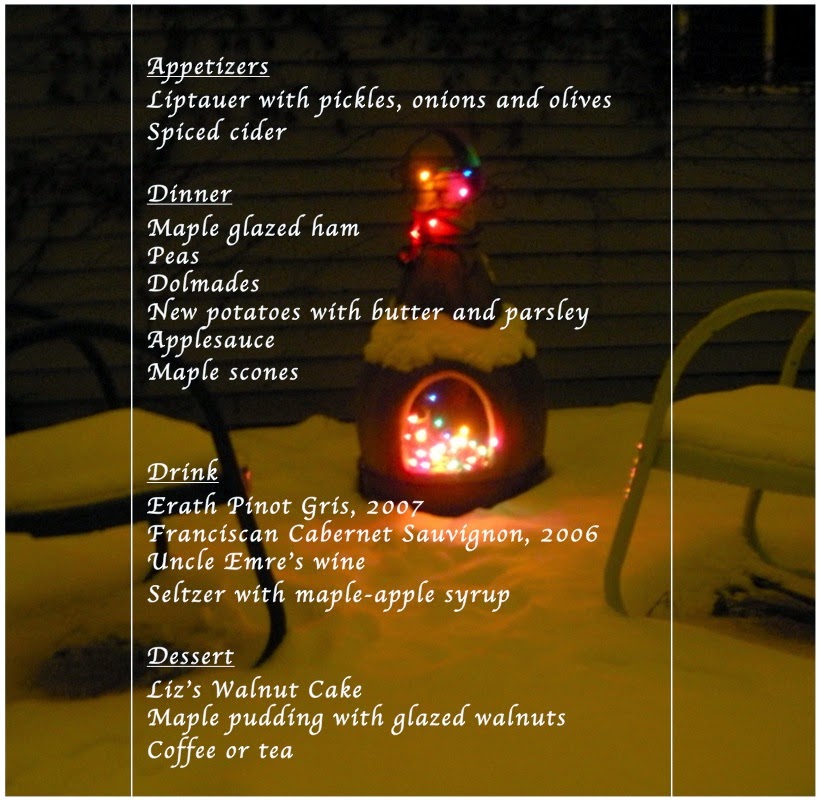
I make menu cards every year for our Christmas dinners, using seasonal photos from the garden. Here are the ones from the past few years.

2008

2009

2011


 ( Don't know where 2010 disappeared to!)

Wednesday, December 21, 2011

Waste not

Apple, pear or peach peels. Cherry pits. Lemon rinds. Orange rinds. Chard stems.

You should not be throwing any of these away. Any time you use a lemon, orange or lime, zest it before you discard the rind. Leave the zest out for a couple of days on a paper towel, or zap it for a minute (literally, just one minute) in the microwave to dry it, and save it in an old spice jar. This will be the best zest you ever use short of fresh, and essentially free.

All vegetable discards, with the possible exception of potato peels, should be thrown in a ziplock and frozen for a quick stock.

Fruit peels can be turned into simple syrups--a couple of cups of peels, a couple of cups of water and some sugar and lemon juice makes enough syrup for a drink or two.

Here's another stick-to-your ribs Dark Days meal for a gloomy cold day, using this principal!

Potato-leek soup, with a twist
1 large or several small leeks
2 very large russets
3-4 white carrots
2 small parsnips
1 small turnip
2 T butter
1 teaspoon coriander seeds
1 teaspoon white peppercorns
Apple stock

Now, then, you've frozen those apple peels from all that apple sauce and pie, right? Right? Good. Because it makes a wonderful stock for soups--sweet and heavy, and able to give vegetarian soups the closest thing to an umami flavor you can get without adding soy sauce.  To make stock, put a quart or more of the peels into a quart of water and boil down to three cups (about 10-20 minutes). Drain and set aside.

Peel and roughly cut, into bite sized pieces, the root vegetables and boil until very soft.  Drain. Slice the leeks and saute in a couple tablespoons of a high-heat oil like grapeseed or olive. Add butter and the drained roots to the pan and stir over medium heat until the butter is melted. Grind the seasoning and stir it in.  Add the stock and simmer a couple hours (or less, if you're impatient). This is not a smooth soup, don't blend it please, you'll want to taste all those lovely chunks.

If you must, fry up some bacon and add it. Cool the soup with a little half-and-half (don't add it directly to the pot; if you reheat this soup with dairy in it, it will curdle).  I served this with homemade cheesy biscuits.

Tuesday, December 20, 2011

A holiday meal

We're having our oldest friends over for dinner tonight.  Even the kids don't argue about setting time aside for dinner with Steve and Gayle every year.

I don't like to make a typical holiday meal of ham or turkey for this family tradition. (I'm not actually making any traditional meals this year--we're having salmon for Christmas day.)  I should probably have made at least an attempt at a kosher meal in honor of the first day of hanukkah today, but I couldn't resist the dip (shell fish and cheese) or the cheesecake.

I love putting together meals like this, thinking through all the courses to make a balance, and to make every course interesting and different.

A good bit of the ingredients are local and seasonal, all of it (with the probable exception of the crab meat) is sustainable and whole:

Appetizer
Goat cheese dip with crab meat
Place in a food processor or mixing bowl: 4 oz crumbled goat cheese, 2 T yogurt, 4 T soft cream cheese, winter or indoor herbs: 2-3 sprigs each. I still had chives, parsley, and thyme outside, and rosemary inside. Add salt and pepper to taste and mix until smooth. Serve with homemade crackers.

Hot spiced cider
Mix in a large saucepan: 1 quart cider, 1 cup orange juice, 1 T each cinnamon (or 3-4 cinnamon sticks) orange zest, 1 teaspoon whole coriander, 1/4 each teaspoon nutmeg, allspice, a few black peppercorns. Heat to a simmer, cover and continue to barely simmer for a couple of hours. Strain through cheesecloth.  Add a little spiced cider liqueur (scroll down to "apple jail fail-redux").

Dinner
Chicken curry with fall vegetables I finally bought a dutch oven, which you really need to finish a dish like this properly, by letting it simmer in the dutch oven for a couple of hours. I served it with local(ish) wild rice and brussels sprouts.

Dessert
Chocolate raspberry cheesecake. I used this recipe from epicurious, but substituted semi-sweet chocolate and semi-sweet milk chocolate melting dots for the white chocolate. I had to add the melting dots when I discovered that you can't melt chocolate in the microwave because it makes it burn. Good news is that I didn't actually burn down the kitchen (scroll down to the photo that says "Ack").

Sunday, December 18, 2011

What's in your larder?

It used to be a common skill--not just knowing how to put up food, but also a sense of how much you'll need.

I've got plenty of fruit to get me through the winter, I think, and peppers, and eggplants. But I don't think I put up enough tomatoes, and I definitely haven't solved the root-vegetable thing. I still just buy them from the year-round CSA which tends to have local veggies well into early winter. I don't have room to grow the beans I know I'd eat-- about 45 square feet yielded just 3 quarts of beans.

Reading the sustainability blogs as one of the managers of this year's Dark Days Challenge, I'm also amazed at the amount of preserving people do. Do they have a million kids or something? People talk about 40 jars of pickles, and 200 jars of tomato paste. People kill, butcher and freeze 5 and 6 and 7 deer.  I start to think that I'm not doing it right.

Last year I made it all the way to May without buying vegetables. This year, I'm not so sure.

Everything in the meal below was made from food I grew, except the seasonings and bacon.

White bean cassoulet with chard
4-6 thick bacon slices
1 tablespoon olive oil
1 1/2 cups chopped onion
1 1/2 cups (1/2-inch-thick) slices diagonally cut carrot
1 cup (1/2-inch-thick) slices diagonally cut parsnip

3 cups white beans (I used Hutterites)
3/4 cup vegetable broth
1 1/2 teaspoon dried thyme
3-4 fresh sage leaves, chopped very fine

1/4 teaspoon salt
1/4 teaspoon black pepper
1-2 large tomatoes, skinned, seeded, then roughly chopped
2 garlic cloves, minced

Garnish:
1/4 cup (1 ounce) grated fresh Parmesan or Romano cheese (not for vegans, natch)
2 tablespoons chopped fresh parsley

Preparation

    Cut up some bacon and fry in a large sauce pan until very well done. Drain and set aside. Using the bacon grease, add onion, carrot, parsnip, and garlic; cover and cook 5 minutes or until tender. (Add a little olive oil, lard, or preserved bacon grease if you need more).  Add stock, beans, enough cold water to cover, sage, and thyme. I'm told you shouldn't add salt to the beans until they are fully cooked because they won't cook correctly, but I don't know what that means. Plus, there's salt in the bacon.  Bring to a boil, and then simmer covered for about 1 1/2 hours, stirring about every 20 minutes.

Add next 4 ingredients and bring back to simmer.  When the beans are just about done, add the bacon, parsley and garlic, and simmer another 10 minutes.

Remove the stems from some chard and blanch the leaves. Place these in the bottom of a bowl and ladle in the cassoulet. Season with salt and pepper to taste, and top with a little garnish of extra parsley.

Thursday, December 15, 2011

I thought you said you don't bake?

I'm a baking machine this fall. I've been doing a pie a week (although not this week--I'll make a quiche to fill that promise this week). Yesterday I threw together some cheesy baking-powder biscuits, and I'm planning a cake for my "Housiversary" (25 years in our house on the 16th!) and a chocolate raspberry cheesecake for dinner with friends next week.

Thank goodness my daughter makes the bouche for Christmas!

Here's another use for those Thanksgiving leftovers!

Cranberry-oatmeal cookies
 2 sticks butter
1 ½ cups light brown sugar, packed
2 large eggs
½ cup cranberry sauce
½ teaspoon orange extract

2 cups oats
1 ½ cups wheat pastry flour
1 tsp baking powder
½ salt

1 cup dried cranberries, plumped

Line a cookie sheet with parchment paper. Preheat oven to 350F/176C. To plump cranberries, place in a pyrex or other microwave-safe container, cover with water and heat on high for 5 minutes. Drain and set aside.

Combine and whisk the dry ingredients. Set aside. Cream the butter, about 5 minutes. Add the sugar and cream until light and fluffy. Add the eggs and beat until smooth, add the cranberry sauce and beat until fully blended. Add the dry ingredients about 1/2 cup at a time, blending fully each time. When done, fold in the fruit using a fork or spatula.

Spoon onto cookie sheet in small teaspoonfuls (about 1" across). Bake for 13 minutes.