Wednesday, January 18, 2012

Stop SOPA and PIPA

Just taking a break for a political statement (since I can't figure out how to actually make the site go dark).

I want to help to raise awareness of two bills in congress: H.R.3261 "Stop Online Piracy Act" and S.968 "PROTECT IP", which could radically change the landscape of the Internet. These bills provide overly broad mechanisms for enforcement of copyright which would restrict innovation and threaten the existence of websites with user-submitted content, such as all those great recipes you love to make, and important articles that get shared on sites like this one. (Thanks reddit for the content, most of which I stole verbatim)

Please take today as a day of focus and action to learn about these destructive bills and do what you can to prevent them from becoming reality.

Make a call.


Sign the petition.

Thanks.  Come back tomorrow for a one-pot meal!

Monday, January 9, 2012

Reconstructing a memory

My mother used to make pineapple-apricot pie using whole fruit. Given that this was the 60s and 70s, she probably used canned fruit; I'm pretty sure I never saw a fresh apricot until I was an adult, but still, this was a whole fruit pie.

Mom kept all her recipes in a little wooden box; after she died I always knew the recipes were in there, but didn't have the heart to open the box. Crispy, crumbly cheese crackers; spice cake with caramel icing; pineapple upsdie-down cake. And this pie.

I've written before about opening the box finally, more than a decade after she died, only to discover that the box was empty. Wrenching.

The pineapple pie is one I've always wanted to make, so I started hunting around the web for recipes, and I can't find one that uses whole, let alone fresh, fruit. One calls for dried apricots, another for frozen pineapple concentrate. All use canned fruit in heavy (!) syrup.  So I'm making it up folks. Call it hubris.

Fresh Pineapple-apricot pie
Crust:
2 cup whole wheat pastry flour
1/4 cup finely ground walnuts
2/3 cup shortening (yes, I use lard)
1/2 teaspoon salt
2-3 T apricot liqueur

Filling:
1 fresh pineapple, cut into bite-sized chunks
2-3 T crystal sugar

1 quart halved, pitted whole apricots
1 tablespoon pure vanilla extract
1/3 cup honey
1/4 cup wheat pastry flour
1 T corn starch
1/4 teaspoon salt

1 large egg white, lightly beaten
2 tablespoons cold unsalted butter, cut into small pieces


Preheat oven to 425

Crust:
Toss the ground nuts, flour and salt, cut in the shortening until crumbly. Add the liqueur one tablespoon at a time, and work it in with a fork, using only enough to wet the dough until it sticks together. Divide into two equal pieces and chill. (You can roll them into thick disks first if you like.)

Butter or spray a 9-inch pie plate. Remove half the dough from the refrigerator. Roll it out on a lightly floured surface to form a disc, 1/8-inch thick and 2 inches larger than the pie plate. If it's a weird shape, as mine always is, trim it and puzzle-piece it into a disc, lightly rolling again to make the extra pieces stick.  Use a spatula to help lift the dough and transfer it to the pie plate. Press it lightly in the plate to fit.  Trim, leaving a 1-inch overhang. Place in the refrigerator to keep cold. You'll use the rest of the dough to create a lattice top. Note: the nut crust is not quite as elastic as a traditional flour crust, so you have to handle it very gently.

For the filling, start by draining off some of the juice from the pineapples: macerate the pieces in the sugar for one hour. Because this recipe uses honey instead of sugar to sweeten, there's a lot of liquid, so don't skip this step. Drain and conserve the juice.*

Once you've drained the pineapple, place all fruit in a large bowl. Toss with the vanilla, honey, cornstarch and flour; mix thoroughly.

Lightly brush the bottom crust all over with the lightly whipped egg white; spoon in the filling and dot with butter.

Roll out the remaining dough and cut nto strips 3/4-inch wide to make a lattice cover over the filling. Trim the overhang to 1 inch. Moisten the edges of the crusts where they meet with a little water, then press them together lightly and turn them under. Crimp the edges.

Brush the lattice crust and the rim with the cream. Optional: sprinkle the surface with 2 tablespoons of turbinato sugar.

Bake 15 minutes. Reduce the heat to 375°F and bake until it is golden and the juices are bubbling, about 50 to 60 minutes.  Let the pie cool on a wire rack before serving. 

*Pineapple syrup
Use the rinds and conserved juice to make a simple syrup: Boil the rinds all in 5 cups of water until the fruit starts falling off the rind. Drain and continue to boil, adding juice of 1/2 lemon, and 1 1/2 cups sugar, until volume is reduced to 2 to 3 cups (depending on how syrupy a syrup you want). Drain thoroughly. Keeps about 2 weeks.

Thursday, January 5, 2012

A Dark Days offering

Seasonal, Organic, Local, Ethical

And vegan (which is about as ethical as a meal gets). All the ingredients in this meal came from my garden, except the chili powder, which is the hot organic from The Spice House.

SOLE chili
2 Thai peppers (or other hot pepper, I just happened to have these)
1 medium onion, diced
1 roasted green pepper, diced
1/4 cup finely chopped cilantro
5-6 small carrots, cut into rough chunks
1 quart roasted eggplant
1 cup heirloom beans (I used Tiger Eye)
 Spinach, 4 oz uncooked
1 quart roasted tomatoes
1 pint tomato sauce
2-3 T chili powder (to taste)

Saute the onion and peppers in a couple tablespoons of olive oil. Add the cilantro and simmer a couple of minutes. Add the carrots, tomato and eggplant, season to taste.  Simmer about 10 minutes, add the beans. Continue to simmer about an hour. Serve with cornbread.

I used the roasted vegetables--peppers, eggplant, tomatoes--that I had cooked and frozen from last summer's garden.

Served with this cornbread, but Snarky Vegan recommends this vegan recipe.

Monday, January 2, 2012

Chamomile

This year's One Seed Chicago choices are chamomile, basil, and cilantro. I think it's the first year that I've actually liked every choice, and would feel just fine no matter which one wins (last tiny sniff for last year's loser- eggplant). I'll do some posts on the other two choices as well.

Therefore, I'm not tipping my hand, (I'll do some posts on the other two choices as well) but I want to depress some misinformation that has started to get out there via Mike Nowak's show during the announcement:
Chamomile is not hard to grow

I first planted chamomile maybe a decade ago. It's the only time I've ever planted it, and yet I get more chamomile every year than I can use. This is because it reseeds. And I just let it go--I have
Grown for a plant sale in 2011
chamomile in the ornamental beds, in the herb beds, in the berry patch, in the tomatoes, in the onions. It's kind of fun to see where it pops up. If it's really somewhere that I don't want it, I let it get about 5 inches tall, and then move it.

Chamomile is pretty, and it behaves itself. Unlike other flowering herbs, like dill, it doesn't get leggy or wild. The biggest drawback of chamomile is that it's a drag to harvest.

I suppose there are probably other uses for chamomile, but primarily I use it for tea. The tea is made from the yellow seed heads, and you want them without the white petals. I wait for the petals to drop, then I grap the top of a given plant, and just hack all the seed heads off with their stems. Then, unfortunately, you have to remove the stems from all the hundreds of tiny seed heads, and any petals that are left. I put it in a pie pan to dry. Don't crumble it (it may fall apart on its own); store in jars.

What you're left with is the most flavorful tea you can imagine. You'll never drink commercial chamomile tea again--the flavor is a pale shadow of the real thing. I grow enough every year to get me through the winter, because you barely need any to make a pot since the flavor is so strong.

As far as next year, it's just about impossible to harvest it all, so some of the seed heads will fall into the soil, and you'll have chamomile next year too. I'm a little worried this year, because a lot of chamomile has sprouted already because of the extended warmth this year.
Self-seeded chamomile in my Savory Walk
Maybe it will be the first year I need to replant! If so, I might get some seeds from One Seed Chicago.

Friday, December 30, 2011

Ginger

I had a large piece of ginger left from the ginger pie (with ginger whipped cream*) thatI made for Christmas, so I decided to play around with it and made honey-candied ginger, pickled ginger, crystallized ginger, and ginger syrup (another "waste not" recipe!)

The honey ginger is the winner.

Ginger Syrup
2 cups water
ginger peels from the other recipes
about 2 cups ginger "stock" from making the candy and pickles

1 1/2 cups sugar
juice of 1/4 lemon
lemon zest
pinch of salt

Make 1 more cup of "stock" by boiling the ginger peels in the water; turn heat to simmer and continue to cook until it is reduced by half. Add to the stock from the other recipes. Add the remaining ingredients and heat until the sugar is completely melted. Continue to simmer until the syrup is reduced by a third to half (depending on how thick a syrup you want). You should end up with about 2 cups of syrup.

Use as pancake syrup, or to flavor tea, cocktails, or sparkling water.

*Ginger whipped cream
1 cup heavy cream
2 T powdered sugar
1/2 t vanilla
1/4 cup ginger liqueur

In a small bowl, whip the cream until it starts to thicken. Add the remaining ingredients and continue to beat until stiff, about 3-5 minutes.  For best results, put the bowl and the beaters in the freezer for at least 3 hours before hand.

Tuesday, December 27, 2011

Playing with pie crust

I did a lot of baking this week and didn't want to make a dessert pie, so I made a quiche instead.

 I always avoided pies because I was afraid of the crust. Well, it turns out the crust is the easy part. I make quiche a lot, but only recently started using my own crust once I realized this. Today I added green tea powder and dried mint (about 1/4 teaspoon each) to the flour, and mixed it with some green mint tea still sitting in the pot from this morning.

After a couple of false starts, I seem to have developed a bit of a knack for a tender and flaky crust.  I've been playing around with the basic recipe; here are some of my variations.

Basic pie crust
2 cups flour (I use a wheat pastry flour)
2/3 cup shortening (yes, I've been using lard, from humanely-raised local pigs)
1/4 teaspoon salt
4-6 teaspoons water

Whisk the flour and salt, then cut in the shortening until it's mixed to pea-sized bits. Add the liquid a tablespoonful at a time, mixing it with a fork, and being careful not to overwork any single portion of the the dough. The more you handle it, the tougher it will be. I've found because lard is so moist, I usually need only 3-4 tablespoons of liquid.

Finish the last bit of combining with your hands, divide dough into two equal pieces and flatten into disks. Put one away while you roll out the other, it's easier to handle when it's slightly chilled.

Some variations:

You can alter the flour. I've substituted
1/4 cup oats + 1/4 cup ground walnuts
1/4 rice flour
mixed white and wheat flour
used only whole wheat (nice for a quiche)

I've add the following to the crust (not all at once):
dried orange zest
a tablespoon of raw sugar (this is nice for dessert pies)
various sweet or savory spices including 
ground coriander, pumpkin pie spice, cinnamon, ground clove
green tea powder
dried mint

You can mess with the liquid you use too. I've substituted
tea (including a green mint)
apple cider
orange juice
liqueur

Sunday, December 25, 2011

Christmas dinner

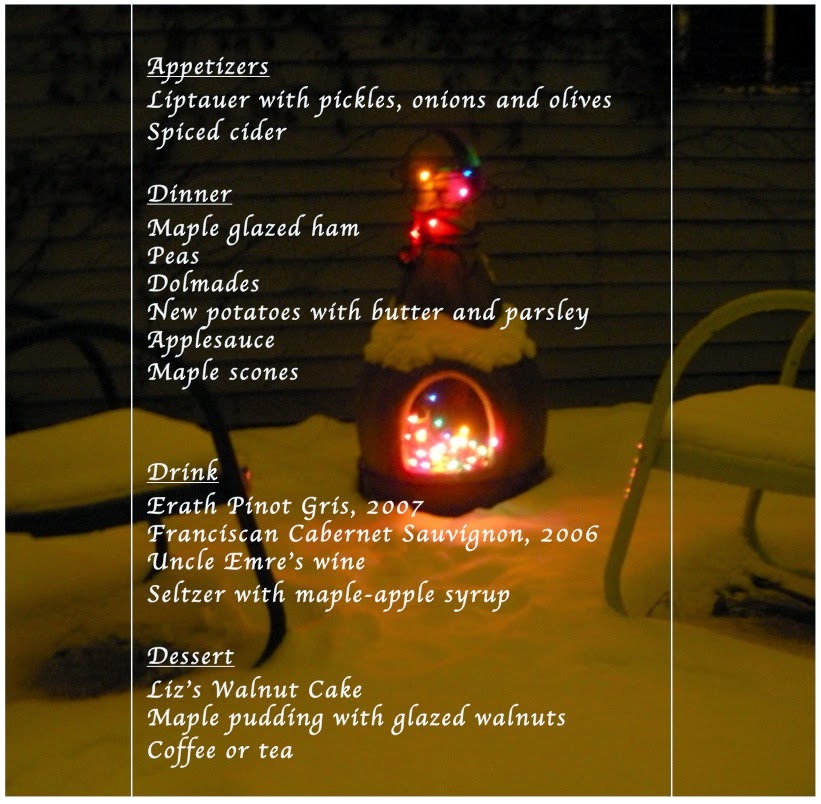
I make menu cards every year for our Christmas dinners, using seasonal photos from the garden. Here are the ones from the past few years.

2008

2009

2011


 ( Don't know where 2010 disappeared to!)